The Rebola Lab
Cellular Mechanisms of Sensory Processing
RESEARCH:
Research Overview
The human brain is composed of billions of neurons interconnected through an even larger number of synapses. A fundamental question in neuroscience is how these complex networks of neurons and their interactions give rise to animal and human behavior. Our laboratory investigates the cellular and network mechanisms underlying sensory perception, with a particular focus on how context and internal brain states modulate sensory processing.
Sensory experiences during wakefulness occur under diverse and dynamic conditions — from the drowsiness of a daydreaming commuter to the heightened vigilance of a climber executing a precise movement. Despite these fluctuations, sensory systems exhibit a remarkable flexibility, allowing them to process afferent information in a context-dependent manner. This adaptability is a defining feature of cortical computation in the healthy brain. Conversely, impairments in such context-dependent processing are associated with neuropsychiatric disorders including schizophrenia and depression. The cellular and circuit mechanisms that shape this flexibility, however, remain incompletely understood.
To address these questions, we employ a multidisciplinary experimental and computational approach, combining electrophysiology, two-photon calcium imaging, optogenetics (in vivo and in vitro), and computational modeling. Our research focuses primarily on the primary visual and somatosensory cortex of mice, aiming to uncover novel cellular and synaptic mechanisms that are fundamental to cortical information processing.
Ultimately, we seek to understand how these mechanisms are altered in pathological brain states, and to identify molecular and circuit-level targets that may hold potential for therapeutic intervention.
Experimental Approaches:
In vivo two-photon calcium imaging
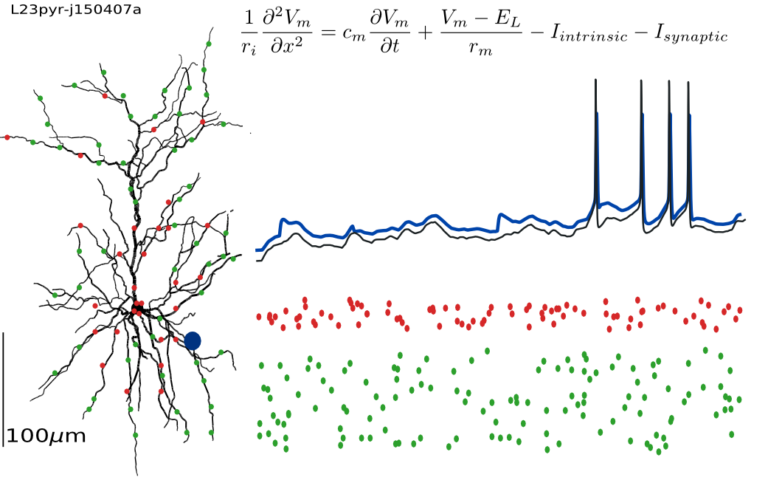
Numerical simulations
Single cell activity and Network Dynamics during Behaviour
Join Us
In the Lab we are highly motivated to pursue scientific excellence and rigor. Always under a highly collaborative atmosphere. Scientific research is challenging and not always easy but can be highly rewarding in that particular moment where working hypothesis became reality. Nothing better than to share that first excitement with your lab colleagues in an hostility-free lab environment. We have open positions for Master students, PhD students and Postdoctoral researchers.
We are always looking for talented people to join the team! Get in touch at nelson.rebola@icm-institute.org, attach your CV and give us a short explanation on your interest in joining the lab.
We are Hiring: Postdoctoral Position Available
We are seeking to recruit as soon as possible talented and motivated post-doctoral fellows with experience in brain neurophysiology that love science and are fascinated by synapses and neuronal circuits.
Location: The Rebola Lab seeks for a highly motivated Postdoctoral fellow to join our team at the Paris Brain Institute, Paris, France.
Date: Starting date September 2027.
Project: The project aims at investigating the cellular and molecular mechanisms involved in the processing of sensory information in the neocortex. The work will mainly focus on the primary visual cortex (V1) and will combine the use of visual stimulation, optogenetics, genetically encoded sensors (e.g. GCaMPs, iGluSnFR3, among others) together with in vivo two-photon imaging and or in vivo electrophysiological recordings e.g. Neuropixels). The laboratory’s research primarily focuses on understanding how variability in synapse function among the different cellular components of cortical microcircuits contributes to the encoding of visual information. Special attention is devoted to investigate how the specification of synaptic function and integration contributes to the unique functional properties of the distinct populations of interneurons in the neocortex and ultimately control processing of visual information (see publications).
Profile: The position will be financed for a minimum of two years. For this position, we are seeking highly motivated individuals with experience in neurophysiology. Candidates with a PhD in Neuroscience or related discipline and demonstrated expertise with two-photon imaging, in vivo recordings and/or computational skills are highly encouraged to apply. Starting date is scheduled to 1/09/2026 but can be adjusted.
Interested candidates should submit a statement of research experience and career goals, a current CV and 2 reference letters to: nelson.rebola@icm-institute.org
Key Publications:
- Morabito* & Zerlaut* et al., Neuron 2025, 113(18):2962-2978.e10.
- De Brito Van Velze* & Dhanasobhon* et al., Cell Reports, 2024, 43(5):114197.
- Bossi* and Dhanasobhon* et al., Neuron. 2022 Aug 3;110(15):2438-2454.e8.
- Morabito A et al, Cell Rep. 2022 Feb 22; 38(8). :110415.
- Rebola N*, Reva M* et al., Neuron 2019, Neuron. 2019 Nov 20;104(4):693-710.e9.
- Rebola N, Carta M, Mulle C, Nat. Rev. Neurosci. 2017 Apr;18(4):208-220.
- Vergnano AM*, Rebola N*, Savtchenko L*, et al., Neuron 2014, 82(5):1101-14
- Carta M*, Lanore F*, Rebola et al., Neuron. 2014, 81(4):787-99.
- Rebola N et al., Nature Neurosci. 2011Jun.;14(6):691–3.
- Rebola N et al. Neuron. 2008 Jan.;57(1):121–34.